Resolution Games Vol. 10
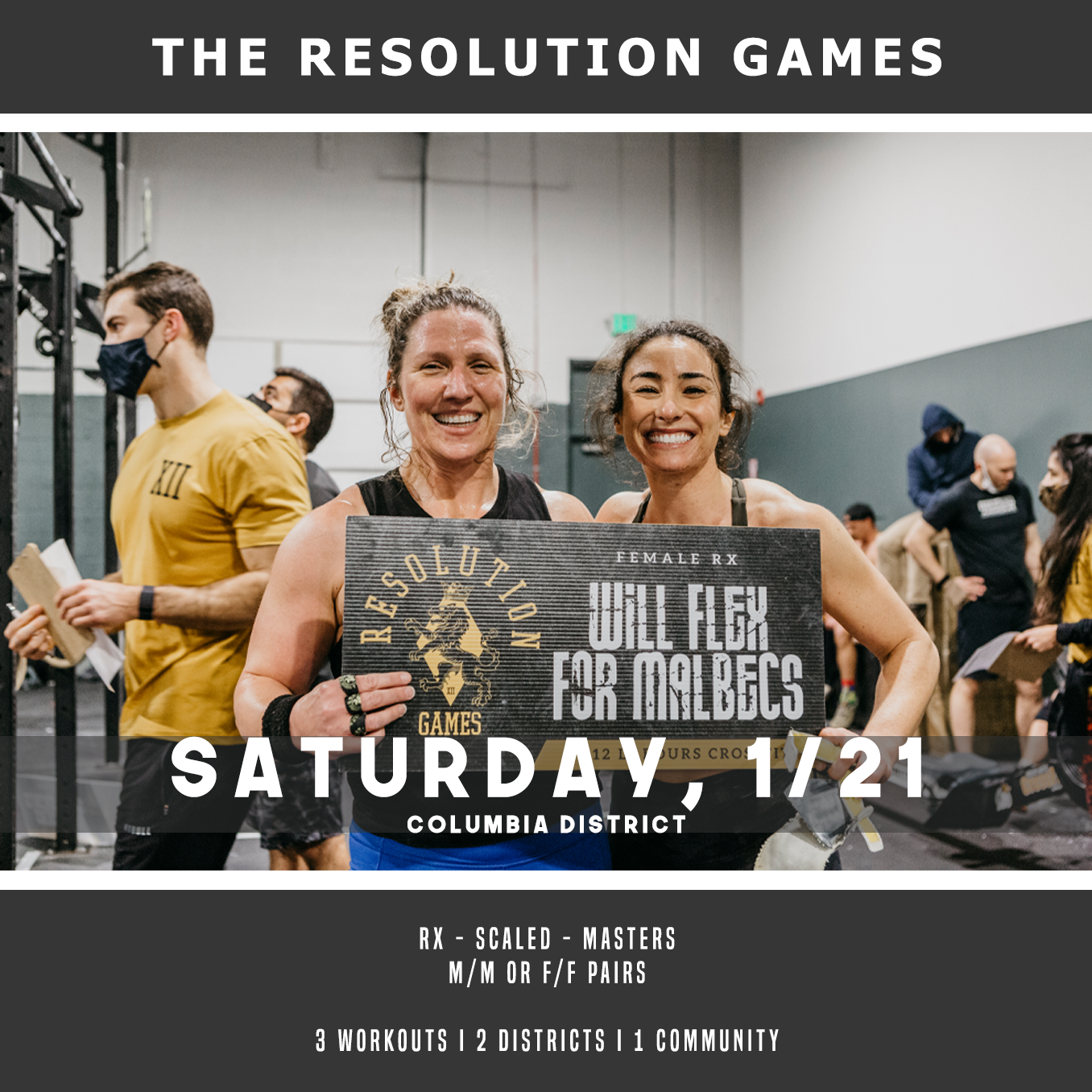
Event Information
Date: Saturday, January 21st
Location: 12 Labours CrossFit Columbia
Address: 9017 Red Branch Road A, Columbia, MD 21045
Registration Deadline: Wednesday, December 28th at 8:00 PM
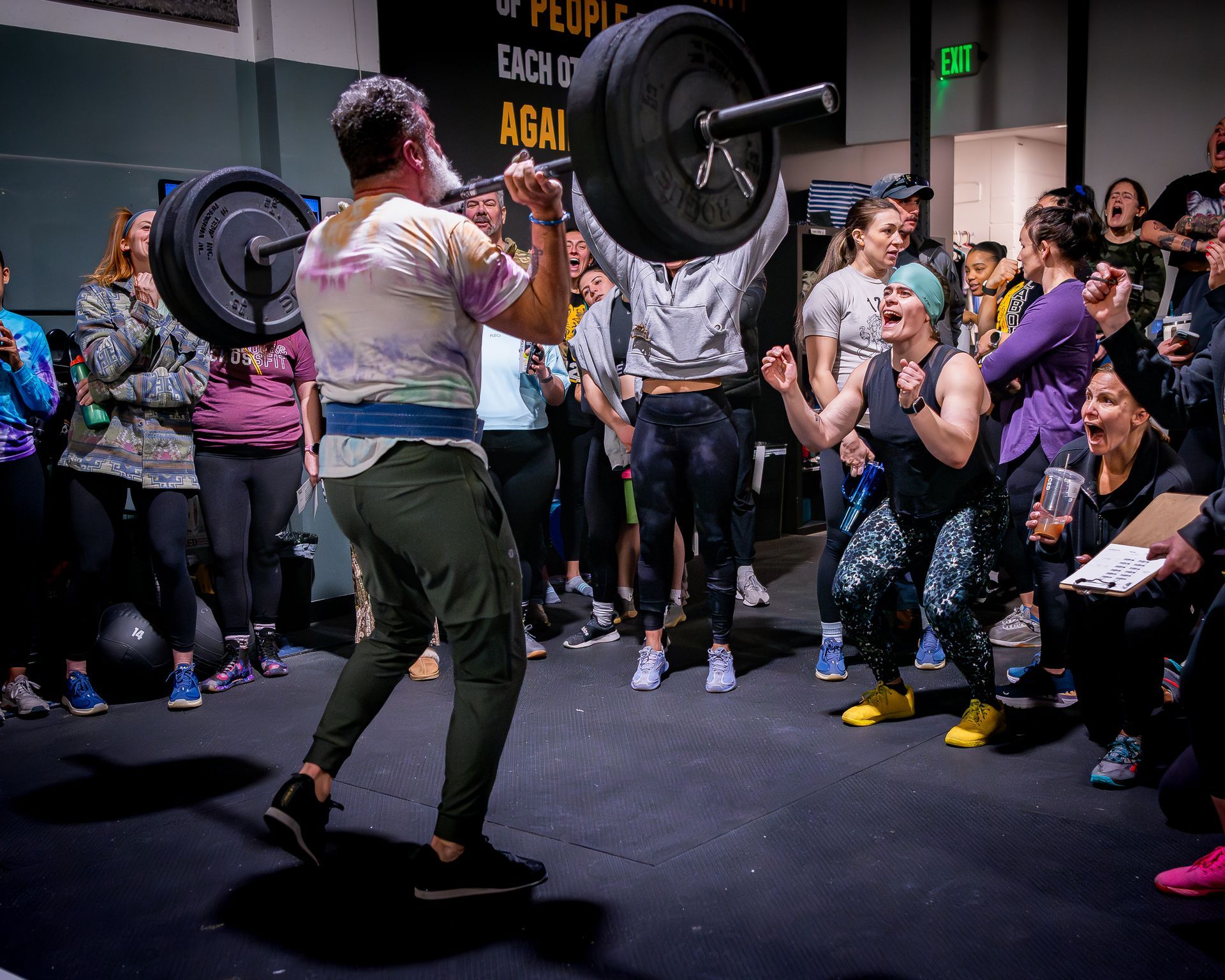
Join the 12 Labours Community for the 10th annual Resolution Games. This is an inter-gym competition for members only. The fitness event will give any level athlete a taste of competition outside your daily class workouts. Test your fitness within the team division as you and you tackle 3 different workouts in pairs.
The fitness event will give any level athlete a taste of competition outside your daily class workouts. Challenge yourself and start your training for the New Year. This is a LIVE way to see how you stack up outside of the Wodify Whiteboard! Fun prizes, t-shirts, and more perks are all advantages of this community event exclusive to 12 Labours members.
Divisions
-
Male/Male Rx
-
Male/Male Scaled
-
Male/Male Masters (40+)
-
Female/Female Rx
-
Female/Female Scaled
-
Female/Female Masters (40+)
*Please note that for the Masters (40+) division, the average age of both athletes must be at least 40 years of age as of 1/21/23.
Volunteer Staff
Join the event team. All volunteers will receive coffee, food, t-shirts, and swag! We are looking to fulfill positions for judges, and equipment crew.
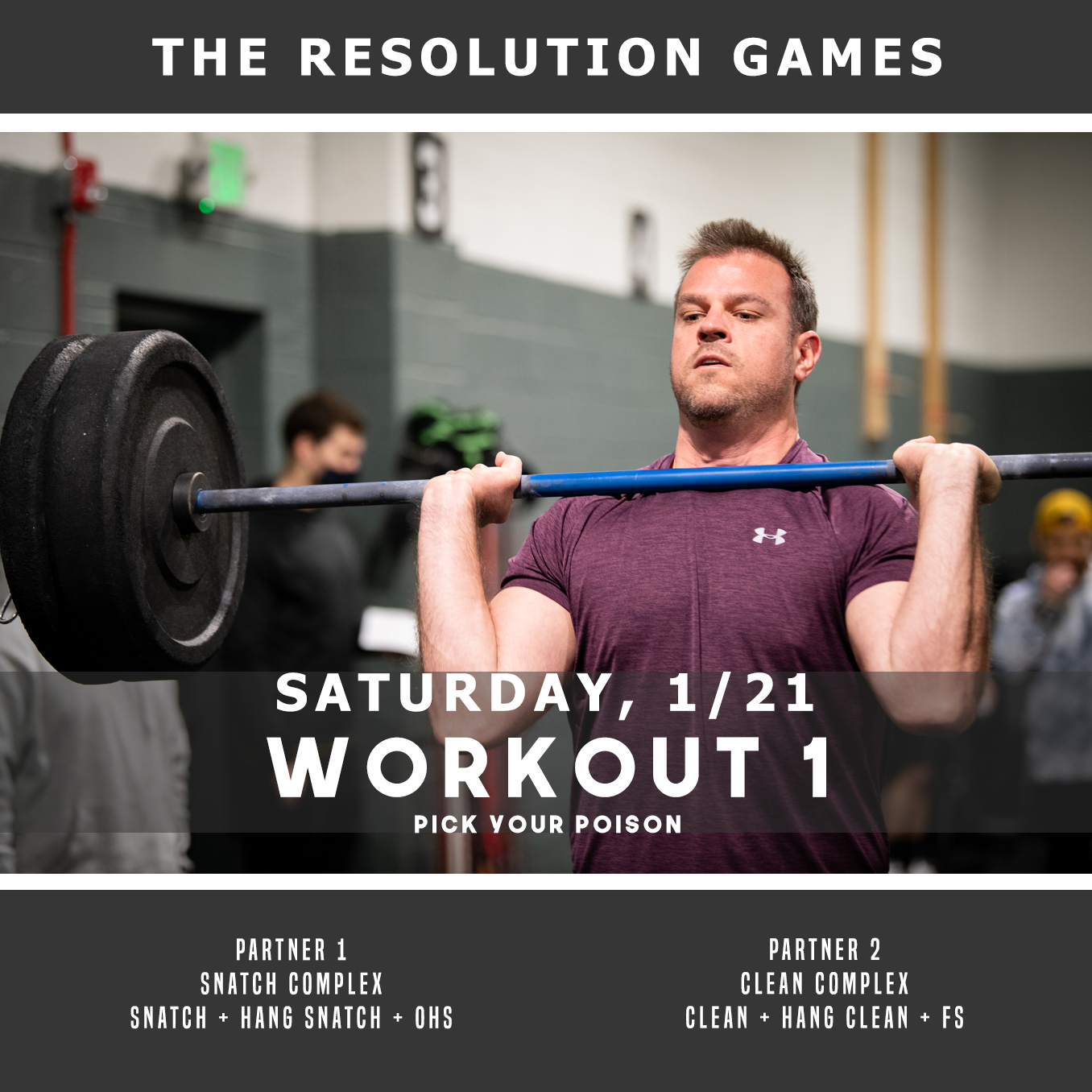
WOD 1 - “Pick Your Poison”
0:00 - 6:00: Partner 1 Performs Lift
6:00 - 12:00: Partner 2 Performs Lift
Partner 1: Snatch Complex: Snatch + Hang Snatch + OHS
Partner 2: Clean Complex: Clean + Hang Clean + FS
Scoring
The score for this workout will be the total weight lifted for Partner 1 and Partner 2.
Flow
At the call of “3,2,1…Go!”, Partner 1 will have 6 minutes to load their barbell and perform a Complex of one Snatch, one Hang Snatch, and one Overhead Squat. The Complex must be completed without dropping the barbell between movements. Partners may assist with loading and unloading the barbell. The Complex must be completed within the required time domain in order for the lift to be considered successful. At the 6 minute mark, Partner 2 will load their barbell and perform a Complex of one Clean, one Hang Clean, and one Front Squat. This Complex must also be completed without dropping the barbell between movements. Once again, partners may assist with loading and unloading the barbell, and the Complex must be completed within the required time domain to be considered successful. At the 12 minute mark when the workout is completed, Athletes will unload the barbells and return the weights to their designated area.
Movement Standards
Snatch: For the Snatch, the Athlete must bring the bar from the ground to the overhead position in one smooth motion. At the top, the arms, hips and knees must be fully locked out with the bar directly over the middle of the Athlete’s body and the feet in line under the body. No part of the body other than the feet may touch the ground during the execution of the lift. A muscle Snatch,
power Snatch, squat Snatch or split Snatch may be used. This is NOT a ground-to-overhead. A Clean and jerk is not allowed.
Hang Snatch:
The Athlete must begin this movement from the hang position, which is defined as the barbell positioned anywhere between the hip crease and the top of the knee. The barbell must be received in the overhead position. Only the feet may touch the ground during the lift. A Muscle Snatch, Power Snatch, Squat Snatch or Split Snatch may be used. The barbell must come to full lockout overhead, with the hips, knees and arms fully extended, and the bar directly over the middle of the body.
Overhead Squat: In the Overhead Squat, the hip crease must clearly be below the top of the knee at the bottom.The rep is credited when the barbell is at full lockout, with knees, hips, and arms fully extended and the barbell directly over the middle of the body.
Clean: The barbell begins on the floor. The Athlete may perform a Power Clean, Squat Clean, or Split Clean. The Clean is successful when the Athlete is at a full stand with knees locked out, hips at full extension, feet directly under the hips, and the barbell in the front rack position with elbows in front of the barbell.
Hang Clean: The Athlete must begin this movement from the hang position, which is defined as the barbell positioned anywhere between the hip crease and the top of the knee. The barbell must be received in the front rack position. Only the feet may touch the ground during the lift. A Muscle Clean, Power Clean, Squat Clean or Split Clean may be used. The rep is credited when the Athlete is standing tall, with the hips, knees and arms fully extended, and the barbell in the front rack position with elbows in front of the barbell.
Front Squat: In the Front Squat, the hip crease must clearly be below the top of the knee at the bottom.The rep is credited when the Athlete is standing tall, with knees and hips fully extended and elbows in front of the barbell.
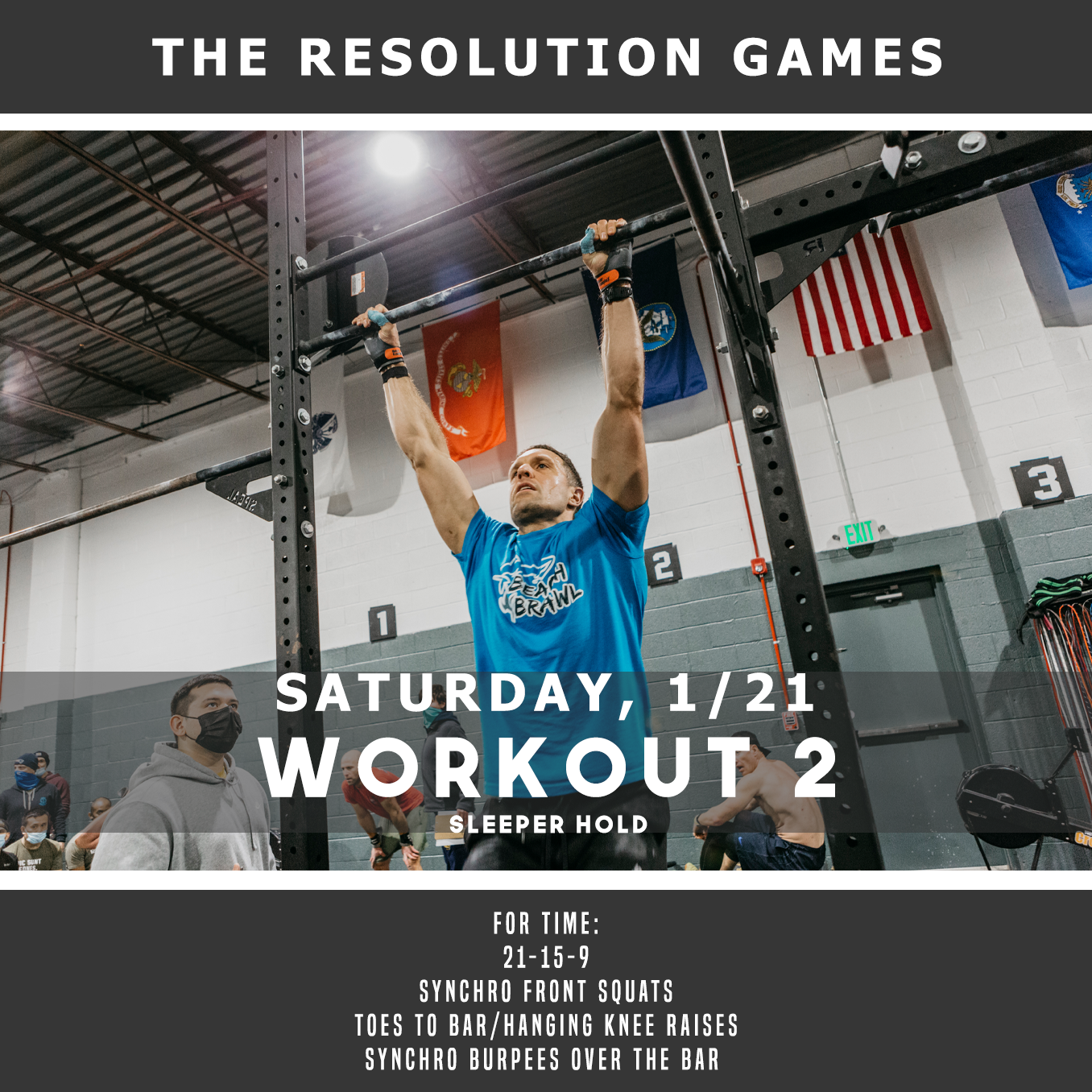
WOD 2 - “Sleeper Hold”
For time:
21-15-9
Synchro Front Squats
Toes to Bar/Hanging Knee Raises
Synchro Burpees over the Bar
Time Cap: 12 minutes
Scoring
The score for this workout will be the time it takes to complete the chipper. Teams that fail to complete the workout in the required time will have 1 second for each rep not completed added to their final time.
Flow
This is a partner style chipper where the required synchronized movements will be done at the barbell. At the call of “3,2,1…Go!”, Partner 1 and Partner 2 will enter the workout floor and perform 21 Synchro Front Squats. Upon completion of the Synchro Front Squats, one Partner will transition to the pull-up bar and begin accumulating 21 reps of Toes to Bar or Hanging Knee Raises while the other partner stands in the waiting area. Partners may split the Toes to Bar or Hanging Knee Raises as they choose as there is no minimum work requirement for this movement. Partners must complete a successful tag at the waiting area before passing off the work on the pull-up bar. Once the 21 Toes to Bar/Hanging Knee raises are completed, both Athletes will complete 21 Synchro Burpees over Bar. Both Athletes will follow this format for the rounds of 15 Synchro Front Squats, 15 Toes to Bar/Hanging Knee Raises, 15 Synchro Burpees over Barbell, and finally 9 Synchro Front Squats, 9 Toes to Bar/Hanging Knee Raises, 9 Synchro Burpees over Barbell. The workout is completed at the time when all movements are completed or when the time cap has been reached.
Movement Standards
Front Squat: In the Front Squat, the hip crease must clearly be below the top of the knee at the bottom.The rep is credited when the Athlete is standing tall, with knees and hips fully extended and elbows in front of the barbell. A Squat Clean may be used to perform the first rep, provided that the Athlete’s hip crease passes below the top of the knee prior to standing.
Toes To Bar: In the toes to bar, the Athlete must go from a full hang to having the toes touch the pull up bar. At the start of each rep, the arms must be fully extended with the feet off the ground, and the feet must be brought back behind the bar and the rest of the body. An overhand or split grip are all permitted. Both feet must come into contact with the bar at the same time, inside the hands.
Hanging Knee Raise (Scaled):
In the Hanging Knee Raise, the Athlete must go from a full hang to having the top of the knee above the hip crease. At the start of each rep, the arms must be fully extended with the feet off the ground, and the feet must be brought back behind the bar and the rest of the body. An overhand or split grip are all permitted. Both knees must reach above the hip crease at the same time.
Synchronized Burpee over Barbell: The burpee must be performed parallel to the barbell. The Athlete will jump the feet back so that he or she is lying on the ground. The chest and thighs touch the ground at the bottom. The rep is credited when the Athlete lands on both feet on the opposite side of the barbell. Synchronization is achieved when both Athletes are on the other side of the barbell with their chest and thighs touching the ground at the same time. Before starting the next rep, the Athlete must again be parallel to the barbell. The Athlete must jump over the barbell from both feet and land on both feet. Single-legged jumping or stepping over is not permitted. The Athlete may step backward one foot at a time when lowering to the ground. On the way up, the Athlete may step forward one foot at a time when rising from the ground. ONLY THE SCALED DIVISION MAY STEP OVER THE BAR.
Rx Division
Front Squat: 135/95
Toes to Bar
Masters 40+ Division
Front Squat: 115/75
Toes to Bar
Scaled Division
Front Squats: 95/65
Hanging Knee Raises
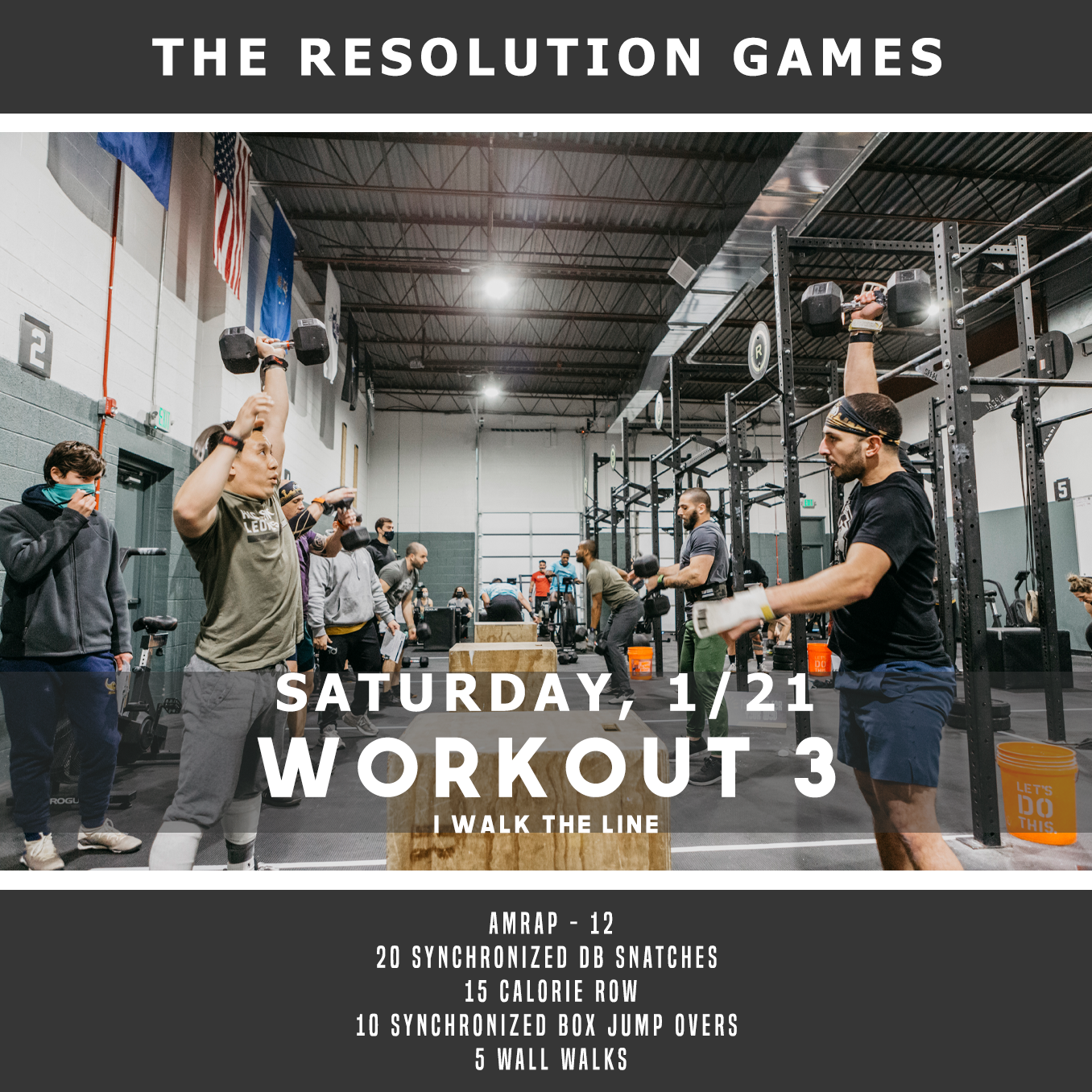
WOD 3 - “I Walk the Line”
AMRAP - 12
20 Synchronized DB Snatches
15 Calorie Row
10 Synchronized Box Jump Overs
5 Wall Walks
Scoring
Score for this workout will be total reps completed during the 12 minute window.
Flow
At the call of “3,2,1…Go!”, both Partners will enter the workout floor and complete 20 Synchronized DB Snatches. After completing 20 Synchro DB Snatches, one Partner will transition to the rower and begin accumulating 15 calories on the rower while the other partner remains in the waiting area. There is no minimum work requirement on the rower and partners may break up the work as needed, with only one partner working on the rower at a time. Athletes choosing to break up the work must complete a successful tag at the waiting area before passing off the work on the rower. Once the monitor displays the required 15 Cals, both Athletes will then perform 10 Synchronized Box Jump Overs before transitioning to the wall. Wall Walks will be performed with one Athlete working at a time. There is no minimum work requirement for the Wall Walks and partners may split up the work as they choose. The non-working Athlete will remain in the designated waiting area, and a successful tag in the waiting area must be completed before passing off the work on the Wall Walks. Once 5 Wall Walks have been completed, both Athletes will return to their DB’s to continue on in this format for the duration of the 12 minute workout. The workout is complete when time is called at the 12 minute mark.
Movement Standards
DB Snatch: The Dumbbell Snatch starts with one head of the dumbbell on the ground. The Athlete must lift the dumbbell overhead in one motion. A Clean and jerk is not allowed. Touch-and-go is permitted, however, bouncing the dumbbell is not allowed. Athletes must alternate arms after each repetition and may not alternate until a successful rep is achieved. The Athlete may not use the non-lifting hand or arm to assist by making contact with the legs or other parts of the body during the repetition. At the top, the Athlete’s arms, hips, and knees must be fully locked out, with the dumbbell clearly over the middle of the Athlete’s body (“lockout position”). Synchronization occurs and the rep is credited once both Athletes have reached the lockout position. Athletes may not receive any assistance in resetting the dumbbell.
Row Erg: The monitor on the rower must be set to zero at the beginning of each row. The Athlete may adjust the foot cradle and damper as needed, but the Athlete may not touch the monitor. The Athlete must stay seated on the rower until the rower reads the required number of calories. In the event of a switch, the working Athlete must remain seated until their partner tags them out. Upon switching, Athletes must have both feet in the foot cradles before beginning to accumulate calories, with only one Athlete working at a time.
Synchronized Box Jump Over: The movement begins with the Athlete’s feet on the same side of the box. Each rep is counted when the Athlete lands on the ground on the opposite side of the box. Synchronization occurs when both Athletes are on the opposite side of the box having landed on both feet. From there, they may begin their next rep. A two-foot takeoff is always required, and only the Athlete’s feet may touch the box. After landing on the box, the Athlete may jump or step off to the other side. Alternatively, the Athlete may jump completely over the box. If jumping over the box, the feet must pass over the box, not around it, and the Athlete must use a two-foot landing. There is no requirement to stand tall while on top of the box. ONLY THE SCALED DIVISION MAY STEP ONTO AND DOWN FROM THE BOX.
Wall Walk: Every rep begins and ends with the Athlete lying down, with their chest, feet, and thighs touching the ground. At the start and finish of each rep, both hands must touch the first tape line (fingers touching is OK). Both hands must remain on the tape until both feet are on the wall. At the top of the movement, both hands must touch the tape line for the 10-inch mark before the Athlete can descend. Any part of the hand may touch the tape line. On the descent, the feet must remain on the wall until both hands are touching the first line. The rep is credited when the Athlete returns to the starting position, with both hands touching the first line and their chest, thighs, and feet touching the ground. Any part of the hand may make contact with the tape line.
Rx Division
Dumbbell: 50/35
Box: 30/24
Wall Walks: 65/55 inches. Taped line is 10 inches from the wall.
Masters 40+ Division
Dumbbell: 50/35
Box: 24/20
Wall Walks: 65/55 inches. Taped line is 10 inches from the wall.
Scaled Division
Dumbbell: 35/20
Box: 24/20
Wall Walks: Wall Walks: 65/55 inches. Taped line is at the top of the athlete’s shoulder.
MORE RECENT POSTS
you can ACHIEVE your goals with us
CrossFit is meant for all levels of fitness, and our universally scalable model is built for you.